
The Dark Tower II: The Drawing of the Three – Stephen King
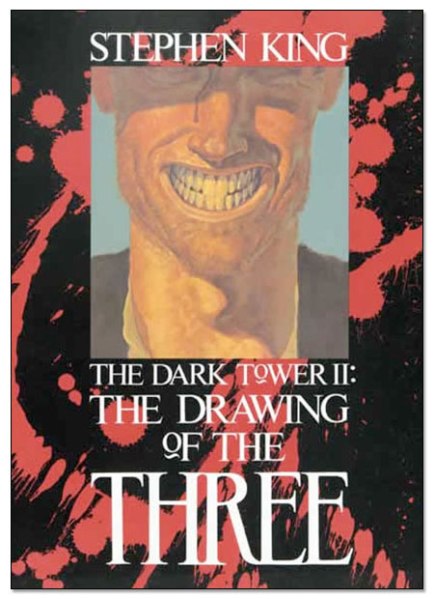
Taking the story in its entirety, The Drawing of the Three is the conclusion of the beginning. Not all of the ka‑tet, the group gathered to quest for the Dark Tower with Roland, is drawn together here. But a fundamental shift occurs as Roland gathers new gunslingers to himself, and the quest can begin in earnest.
Going back to a novel you haven’t read since high school is like reading it for the first time, particularly for those of us who have poor memories to begin with. I remembered the very broad strokes here, but none of the particulars, which is something I expect to be a recurring theme during this adventure.
The Drawing of the Three begins immediately after The Gunslinger ends. He wakes up on a beach, a night tide quickly encroaching on this gun belt, with a new urgent problem to contend with. Namely, horrifying Labrador‑sized lobster‑like sea creatures that very quickly eat some of his fingers and toes while gibbering a series of nonsensical questions: “Dad a chum? Did a chick?” [shudder]
Thanks to the bites, Roland is poisoned, possibly dying, and increasingly desperate. That desperation propels The Drawing of the Three with an urgency The Gunslinger lacked. Right from the start, Stephen King resets the stage and firmly establishes a new framework for this installment. By taking away the one thing Roland can be counted on to perform with expert precision, his deadly shooting skills, he is forced to rely on his wits, his faith in ka (destiny), and other people.
As was prophesied in The Gunslinger, this novel focuses on the “drawing” of the next members to join Roland on his quest for the Tower. While stumbling along the beach, half delirious with fever, Roland comes upon a freestanding door with the words The Prisoner etched upon it. By walking through the door Roland finds himself inhabiting the mind of another. In short order we meet the junkie Eddie Dean, followed by the schizophrenic Odetta Holmes/Detta Walker, and finally serial killer Jack Mort.The novel is grouped into acts based on the three different doors.
The most straightforward is focused on Eddie Dean in 1984. This arc is a fast-paced, pulpy crime story as Roland meets Eddie, attempting to smuggle drugs from the Bahamas into New York City, and the trouble the duo runs into along the way that inevitably leads to a large gunfight that Roland and Eddie escape by exiting back to Roland’s world.
Door number two, The Lady of Shadows leads to Odetta Holmes/Detta Walker in 1964. The Lady is two distinct black women who live in the same body but are unaware of each other. Odetta is kind, compassionate, and strives for social justice. Detta is vindictive, angry, and murderous for slights real and imagined.
Upon rereading, the similarity between Sméagol/Gollum in The Lord of the Rings and Odetta/Detta is striking. I think King was playing off the disappointment the reader feels that, ultimately, Sméagol could not be redeemed. Here, the climactic psychic confrontation between Odetta and Detta creates a new persona combining the best traits of the two: Susannah.
The final door leads to Jack Mort, and we quickly learn of his prior intrusions into Odetta’s life, causing Detta to emerge in the first place. This section demonstrates Roland’s own righteous anger and we see him as an enforcer of justice for the first time. Roland very quickly learns that Mort is an unrepentant serial killer and takes control of his body, never relinquishing it. With Eddie, Roland’s possession was symbiotic; the two helped each other. Roland spent only moments in Odetta/Detta before bringing her through the door. With Mort, Roland’s disdain toward the man leads him to drive his body on a smash‑and‑grab expedition through New York City to procure guns, ammo, and the all‑important antibiotics.
By the end of the novel, the trio of gunslingers is in an uneasy alliance. Eddie and Susannah both know Roland will cast them aside for the Tower. Roland all but acknowledges this, but for the first time admits that any sacrifice will be for the greatest good—because the group is not just to reach the Tower, but somehow to save it and all of creation in the process.
“We are going to go, Eddie. We are going to fight. We are going to be hurt. And in the end we will stand.”
All writers go through stages, and this era of King’s life was his most prolific and striking. The Drawing of the Three was released in a very limited hardcover in 1987; a paperback edition did not follow until 1989. In the years between The Gunslinger and The Drawing of the Three, King published Different Seasons, Pet Sematary, Cycle of the Werewolf, The Talisman, The Eyes of the Dragon, and IT. Oh yeah—and what most Constant Readers consider his greatest short story collection, Skeleton Crew. Prolific isn’t a strong enough adjective for this output in such a short time. The fact that this list includes some of his best (and most notorious) novels is truly extraordinary.
During this period, King was writing like a man possessed, which is exactly the feeling I got reading The Drawing of the Three. Whereas The Gunslinger presented a young writer putting his own spin on Frodo’s quest by mixing it with the Western iconography of Sergio Leone, The Drawing of the Three is a singular work; one that is emblematic of King’s experimental nature, which pervades the Dark Tower series.
A crucial event happens during the Mort escapade when Roland intervenes to prevent the murder that would have sent Jake to the desert Way Station, where he met Roland. This paradox will have crucial ramifications for Roland, Jake, and the entire quest in the next novel, The Waste Lands. Until then, long days pleasant nights!
Categories


