
The Dark Tower I: The Gunslinger – Stephen King
[Note, as mentioned in the introduction to this series here these articles will be full of spoilers. These are not reviews, but my thoughts on each volume and how it fits into the larger uber-narrative.]
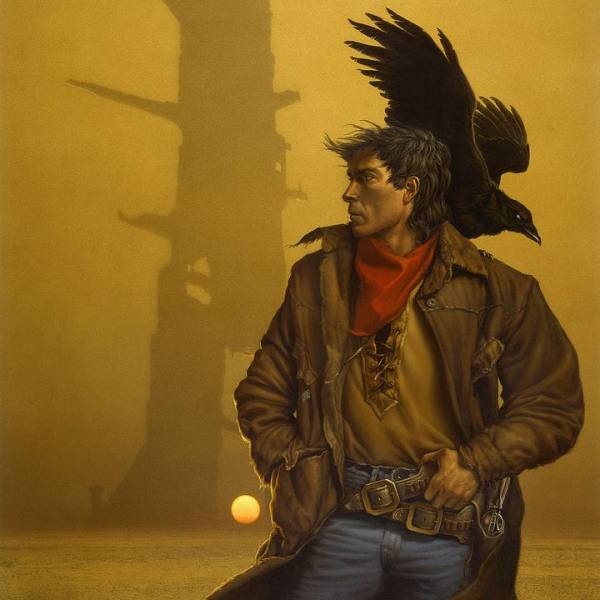
“The man in black fled across the desert, and the gunslinger followed.”
Few opening sentences are more iconic in fiction. Few so perfectly encapsulate a novel so succinctly. There are tangents and sojourns as should be expected in a novel that began as loosely connected short stories, but for the most part Stephen King’s The Gunslinger is focused on that central pursuit.
Roland Deschain, the last gunslinger and sole prince of a long-fallen kingdom, has been charged with a holy mission he doesn’t fully understand. He must reach the Dark Tower, and the first major milestone on that journey is to catch the man in black.
How long has Roland been chasing the man in black? He doesn’t know. Time is funny since the world has “moved on” in Mid-World. He also doesn’t know what the Dark Tower is, what it does, or what he’s supposed to do once he reaches it. Those answers, he has surmised, are held by the man in black. So Roland must catch him.
The Gunslinger is one of King’s oddest books, a sentiment that will likely be repeated many times during this book journey. Since the initial publication in the early 80s, and after the completion of the full 7-volume epic, King has made several revisions to the book to better tie it to the installments that followed. I’d wager no one is more surprised than King himself that nearly his entire body of work over 50+ years is connected one way or the other to the epic that begins relatively quietly here.
What stands out to me on this re-read is Roland’s style of speaking, and the language he uses is much more aligned with the later installments than originally. Also, memories and references to people in his past, especially Susan Delgado, is much more explicit in this revised version. After the mentions of her here, along with the events of Mejis (detailed in volume IV, Wizard & Glass) I’m curious if there were references to her in The Drawing of the Three and The Wastelands. I’m guessing not, as King hasn’t revised any of the later novels as far as I know.
The uncanny ability Roland possesses for violence is also something I had forgotten. A gunslinger in Roland’s world is a knight, and to become a gunslinger is to have endured torturous training, which is detailed here, to hone those skills to a preternatural level. The massacre of Tull is a breathtaking action sequence where the horror only hits after the guns have finished speaking peace.
Roland’s relationship with the boy Jake Chambers hits different when you know everything that is coming. The appearance of Jake at the way-station in the desert is the first hint from King that The Dark Tower isnt going to go where you expect. Jake has come from what seems to be New York City, after being run over by a car in the street. How and why he ended up in the middle of a desert he doesn’t know and his memory of that other life is quickly receding from his mind. The quicksilver quality of time and slippery nature of memory are recurring themes here. All Roland knows is that he cares for the boy, even loves him, and that quick familiarity is the first of many hints that this may not be the first time Roland has met Jake.
Even Jake’s notorious death scene is different from what I remembered. My memory of this book is that Jake is falling from the railroad trestle inside a dark mountain and Roland is attempting to save him. The man in black appears at the end of the tunnel and tells Roland this is his one opportunity to catch him but he has to let the boy go. Seeing this, Jake utters the 2nd most iconic line in this entire series, “Go then, there are other worlds than these.” and Jake lets go to fall to his death.
The reality is far grimmer. In actuality, Roland makes no attempt to save Jake, and Jake lets go after Roland leaps over him to pursue the man in black out of the tunnel, speaking his prophetic line after Roland is already on the move. Roland’s ruthlessness is evident here from the start, a quality we saw repeatedly here and will continue to see.
As the novel draws to a close and the man in black (revealed to be Marten, advisor to Roland’s father) and Roland have their long awaited palaver, Roland is left with more questions than answers. After an abundance of tragedy and violence, The Gunslinger ends on a hopeful note. One that will be shattered in the opening pages of volume II, The Drawing of the Three.
On that I will only say, “Dad a Chum?” “Did a Chick?”
Do ya ken?
Categories


