
Locked (2025)
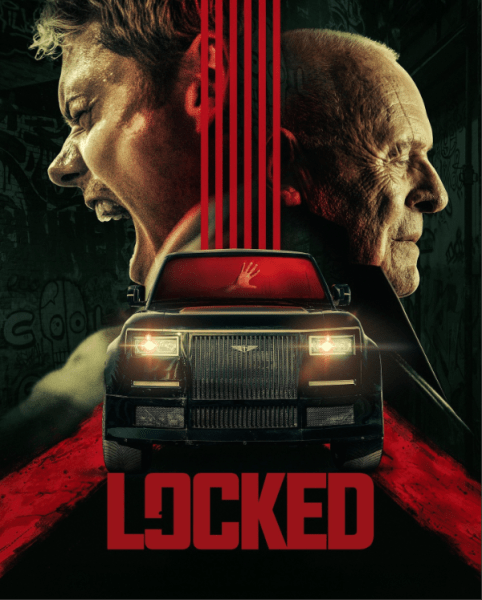
I legitimately dig this one-sheet.
So, I heard there was a movie where Bill Skarsgård breaks into Sir Anthony Hopkins’ car, leading to a claustrophobic game of wits between two of cinema’s finest thespians.
Or at least, that’s the movie I was looking for when I found Locked.
I’ve kind of already given you the setup: Skarsgård plays Eddie, a small-town street hustler who aspires to turn his life around for the sake of his estranged daughter, Sarah (Ashley Cartwright). He’s unambiguously presented as an inherently decent guy who just can’t get his life together because he’s predisposed to making impulsive decisions rather than planning his actions logically.
For reasons we don’t need to explore here, Eddie just needs $500 to get his life back on track and start making an honest living. It sounds dramatic, but I can remember a moment in my own past where I needed roughly that amount of money—and fast—to keep a roof over my head.
For many, this is an inflection point beyond which they either make it another month or end up a career criminal.
Well, this is Eddie’s moment.
He gives himself room for one more robbery and quickly spots a ludicrously expensive SUV parked in a sketchy urban lot. He finds the door conveniently unlocked and excitedly lets himself in. I’ll assume it’s no secret to you that he’s gotten into the wrong SUV, since it’s the premise of the film.
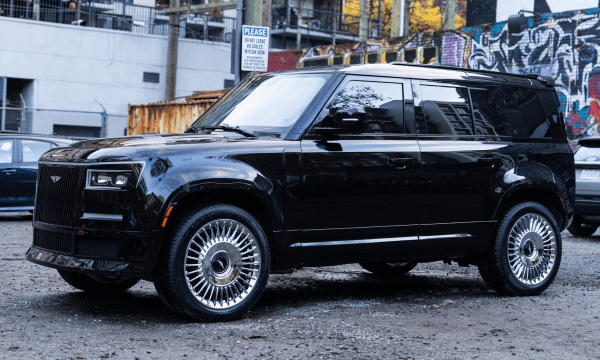
But it looks so right…
William (Anthony Hopkins) is the owner, a wealthy doctor suffering from terminal cancer who has sunk a considerable portion of his wealth into Eddie’s temporary home. William’s SUV is fitted with James Bond levels of security, soundproofing, and passenger pacification.
He can communicate with Eddie using the vehicle’s onboard audio, giving the story its initial burst of tension. Eddie finds himself trapped in a rolling torture chamber—impenetrable, soundproof, and filled with painful surprises. Unable to escape using raw strength or sheer determination, he decides to engage William and appeal to his sympathy.
Sadly, this is where the movie unravels, almost as quickly as it blossomed. One moment, there is an intriguing narrative promise governed by logical order standing before your eyes—and then, in a flash, it’s gone. And in the end, we find that the flaw was built into the underlying structure of Locked all along.
Let’s be clear: Skarsgård and Hopkins deliver the goods. The former ably holds the screen for most of the run-time, acting primarily against a weaponized luxury vehicle. Hopkins is primarily heard rather than seen, but his immense gravitas lifts both the corny dialogue and the increasingly troubling actions of his character to levels the material itself fails to earn.
The problem is that the story establishes Eddie and William’s individual character very early on, and neither man evolves to the point where we feel they’ve grown or that we’ve learned anything meaningful alongside them. Eddie is a flawed but mostly decent man who made a poor choice; however, he is not complex enough to challenge our notions of right and wrong.
William, on the other hand, is driven by something equally simplistic and, as such, lacks the nuance to be tragic.
I don’t want to give too much away because Locked truly is worth watching, if only for Eddie’s suffering at William’s hands inside the vehicle. It’s wonderfully shot and staged, giving us the feeling that we’re not just trapped inside with the victim, but are actively ensnared within a living, breathing, highly malevolent ecosystem.

Hot seat.
What’s most disappointing about Locked is that the film never fulfils its own setup. Each character’s motivation is fixed from the start and never develops. Eddie may be a criminal, but he hasn’t committed to that path—he’s still engaging in small acts of economic desperation rather than living as a full-fledged burden on society.
William is, by conventional standards, a very successful man, but inside, he is a blackened and broken husk. And thanks to his own trauma, he seems to have forgotten what it means to be human.
Locked raises tantalizing questions—whether it’s acceptable to break the law for family, whether mercy can temper justice, and whether vigilante punishment can ever be justified—but instead of fully weaving them into the narrative, it gradually lets them drift away. For roughly thirty-ish fascinating minutes inside the SUV, those thematic possibilities feel alive before the story begins to shift away from meditation on justice and toward something more conventional and, ultimately, dull.
It abandons all philosophical pretense and settles into a primal struggle between an insanely desperate man and a desperately insane one.

You decide which.
There’s a better movie buried inside Locked than what ended up on screen. It would have leaned more into ambiguity—maybe Eddie was a little less inherently sterling. Perhaps William would exhibit a more apparent distinction between his wildly disparate mental states. It might have stripped away the manipulative “sassy child” subplot and allowed us to truly wonder which of these two men, if either, inherently deserved our sympathy.
At times, Locked edges into exploitation—not that it ever descends to cheap schlock, but in the way it revels in pulp tension and physical suffering. That gives it a specific raw energy, and when paired with such A-list talent and expert execution, it really works in certain moments. But the pity is that the overall story never rises to meet the level of visual craft.
As I mentioned, Locked is visually rich, and it’s obvious how much care went into immersing us in its environment. I’ll chalk this up to director David Yarovesky, perhaps best known for the viscerally arresting Brightburn, and producer Sam Raimi, who needs no introduction.
I was legitimately fascinated by the SUV, named “Dolus” (a Latin word alluding to “deception”—had Eddie bothered to Google the name, we might not have had a story at all), and couldn’t stop wondering how much William must have paid for this terrifying vehicle—something Goldfinger himself would envy—when he could have just hired three hyper-aggressive ex-Marines to make the same point.

But then, we’d never have gotten this.
The irony of Locked is that the filmmakers accomplished the impossible part—making a ninety-minute thriller inside a car look and feel exciting—but were less successful at the easy part: giving the characters enough dimension to matter. William builds a machine so mesmerizing that I’m still imagining I own it.
But the story never convinces us why it had to exist. Eddie’s internal life isn’t much better, reliant on a trope so familiar that even the most casual moviegoer might roll their eyes. The result is a film that’s kinetic, stylish, and very much worth experiencing—but one that leaves obvious opportunity for more fertile storytelling just sitting there, untouched.
Come to Locked for the premise, stay for the acting—but do not go in with lasting expectations.
Categories

Bruce Hall View All
“When some wild-eyed, eight-foot-tall maniac grabs your neck, taps the back of your favorite head up against the barroom wall, and he looks you crooked in the eye and he asks you if ya paid your dues, you just stare that big sucker right back in the eye, and you remember what ol' Bruce Hall always says at a time like that: "Have ya paid your dues, Bruce?" "Yes sir, the check is in the mail."
 CRITICULT - Telling you what's up since 2003.