
Superman (2025)

Hot damn, we finally have a Superman movie worth celebrating.
For nearly a century, Superman has remained one of the most beloved fictional characters of all time. Originally an exercise in Depression-era wish fulfillment, the Man of Steel was an outsider—an alien from another world who looked just like us, and chose to use his extraordinary gifts to repay and safeguard the society that had accepted him. He was the creation of two Jewish kids from Cleveland, Jerry Siegel and Joe Shuster, trying to make their mark in the crowded world of pulp comics.
Over the years, Superman has been many things to many people: a populist champion, an avatar of law and order, a colorful inspiration to kids.
But on screen, at least since Richard Donner left the franchise in the 1980s, he’s mostly been… mediocre.
Confining things to this century alone, Superman Returns (2006) had polish, strong visuals, and a talented cast. But it gave us a hero adrift in his own story, never convincing us he was fully committed to being Earth’s guardian. Man of Steel (2013) delivered scale, ambition, and no shortage of brooding, but leaned so hard into grit and darkness that it stripped away the very qualities that make Superman who he is.
Then came the preposterously titled Batman v Superman: Dawn of Justice (2016). It has its defenders.
They are wrong. It is terrible.

Martha! Marthaaaaaaaaaaa!!!!!!!!
So, it’s against that backdrop that James Gunn’s Superman (2025) arrives. Gunn is the quirky visionary behind Marvel’s Guardians of the Galaxy trilogy, the unexpectedly sharp Peacemaker (2022– ), and Slither (2006), the horror-comedy creature feature your genre-nerd friends wouldn’t shut up about that spring. His style—earnest, colorful, and unapologetically weird—fits the superhero genre like a glove.
The result is a bright, engaging film that occasionally overreaches but ultimately works because it believes in its own source material.
This means rather than dragging us through the origin story everyone already knows, Superman just drops us straight into the action. This world has already lived three years with the Man of Steel (David Corenswet), and he’s been rewarded with a groundswell of public support. This version of the character feels closer to the Superman your grandparents might have grown up with—wholesome, kind, and more than a little naïve.
Which is probably why we’re introduced to him at a moment of defeat – his first real setback after a long streak of success.
It’s worth noting that in this universe, Superman is slightly less invulnerable than we’re used to. He can be hurt, he does have weaknesses (other than kryptonite), and he does, occasionally, require healing. This may seem like a small thing, but it’s the most significant and essential change Gunn makes to the character. De-powering Superman a bit makes him more human and therefore relatable. It also makes it easier to introduce credible stakes to the story without requiring Superman’s support system to consist of fools. Rather than relying on Lois or Jimmy to get themselves into trouble, our hero can be directly threatened.
Of course, this requires Superman to use his intellectual creativity to solve problems, rather than just “Supermanning” them with a gigantic punch or a blast of laser vision.

Supermaaaaaaannnnnn!!!!!
We also learn that this iteration of the Man of Tomorrow, for all his inherent goodness, struggles with strategic thinking. That blind spot echoes in his private life too, as Clark Kent, mild-mannered reporter for a great metropolitan newspaper. Clark and Jimmy Olsen (Skyler Gisondo) share a jocular, big-brother/little-brother vibe where it’s not always clear who’s guiding whom. Clark and Lois Lane (Rachel Brosnahan) have been together for several years, with Lois long aware of his secret.
Their relationship is warm, but it’s also complicated, as both make questionable professional compromises to keep his dual identity hidden.
For all his physical prowess, Superman would seem to remain prone to some of the same intellectual blind spots as the humans he protects.
Things get truly real when Superman inserts himself into international affairs, eroding some of his public goodwill and drawing the attention of billionaire agitator Lex Luthor (Nicholas Hoult), setting the stage for their inevitable collision.
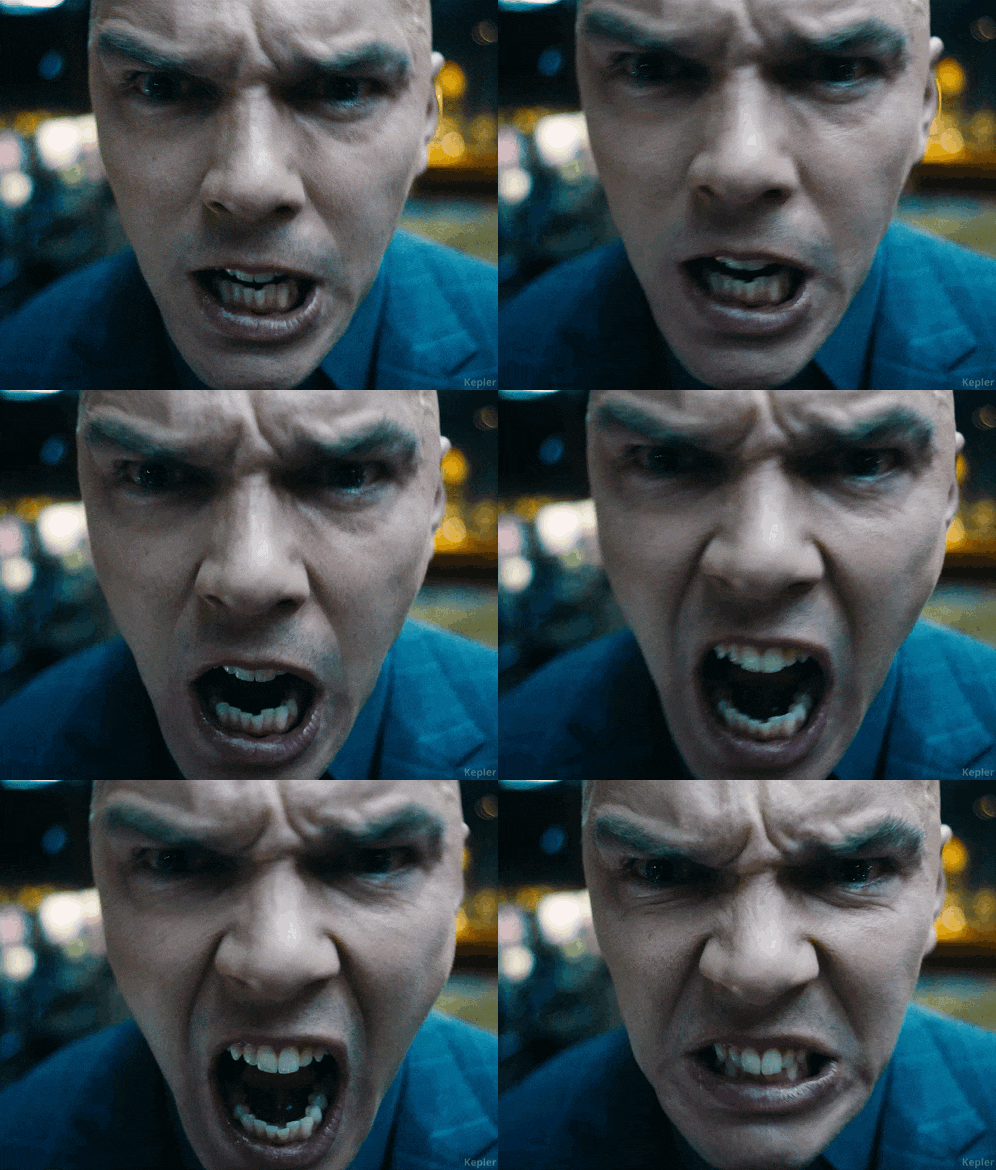
Supermaaaaaaannnnnn!!!!!
Without wading too deeply into the plot, this is a story built on contrasts: heroic naïveté against villainous hubris, individual action versus institutional reliance, and an iconic hero surrounded by a surprisingly crowded bench of supporting players. Gunn replaces Zack Snyder’s Justice League™ with the “Justice Gang”—Green Lantern (Nathan Fillion), Hawkgirl (Isabela Merced), and Mr. Terrific (Edi Gathegi, an eccentric delight).
They’re bankrolled by another billionaire, morally ambiguous tech-bro Maxwell Lord (Sean Gunn), which lends their crimefighting some political legitimacy. Superman, by contrast, acts entirely on his own authority—which some find easy to view with suspicion. That distinction becomes a key tension in the story, one of many layers that give the film more heft than expected.
Somehow, it all holds together.
For a film juggling this many characters and ideas, it’s surprisingly coherent, and the main reason is a sharply written script and a cast capable of delivering it. Corenswet’s Superman is a throwback: cheerful, sincere, maybe even a little dorky—but his heartfelt optimism feels sharp in contrast to the ethically malleable world around him. Brosnahan’s Lois is unique and contemporary while (seemingly) paying some level of homage to Margot Kidder’s iconic interpretation.
Had she lit a cigarette mid-scene, I could have died a happy man.

❤❤❤❤
And with all due respect to Gene Hackman, who was not asked to dig nearly as deep, Nicholas Hoult may have delivered the definitive live-action Luthor: a cocktail of charisma, smug intelligence, and Hannibal Lecter-level psychopathy that keeps Gunn’s film from floating away on its own inherent cheer.
Since no Superman conversation is complete without mentioning the suit, let’s talk about the suit.
The classic spandex wouldn’t fly in today’s UHD world, and the trunk-less look has already been (successfully) done. What we get here is something in between—a sculpted, rubbery design, not quite the Man of Steel armor-adjacent look and not quite the Spirit Halloween feel of Dean Cain’s threads. It’s not a dealbreaker, but I never stopped wondering how, in-universe, Clark settled on something that looks like it takes ten minutes to peel off.

Sometimes you wear your underwear on the outside. Sometimes the outside IS the underwear. Deal with it.
The old conceit—that he could wear it under his clothes and spring into action instantly—is harder to picture here, and it slightly undermines the fantasy of Superman’s immediacy.
Still, these quibbles fade next to what Gunn gets right. After years of watching live-action Superman adaptations bend under the weight of self-doubt and reinvention, it feels like a gift to experience a version that just lets the guy be who he is.
Not an alien god. Not a wistful ghost. Not a grim messiah.
Just Superman—strange visitor from another planet, who just happens to be a really good dude.
Categories

Bruce Hall View All
“When some wild-eyed, eight-foot-tall maniac grabs your neck, taps the back of your favorite head up against the barroom wall, and he looks you crooked in the eye and he asks you if ya paid your dues, you just stare that big sucker right back in the eye, and you remember what ol' Bruce Hall always says at a time like that: "Have ya paid your dues, Bruce?" "Yes sir, the check is in the mail."
 CRITICULT - Telling you what's up since 2003.