
The Monkey (2025)
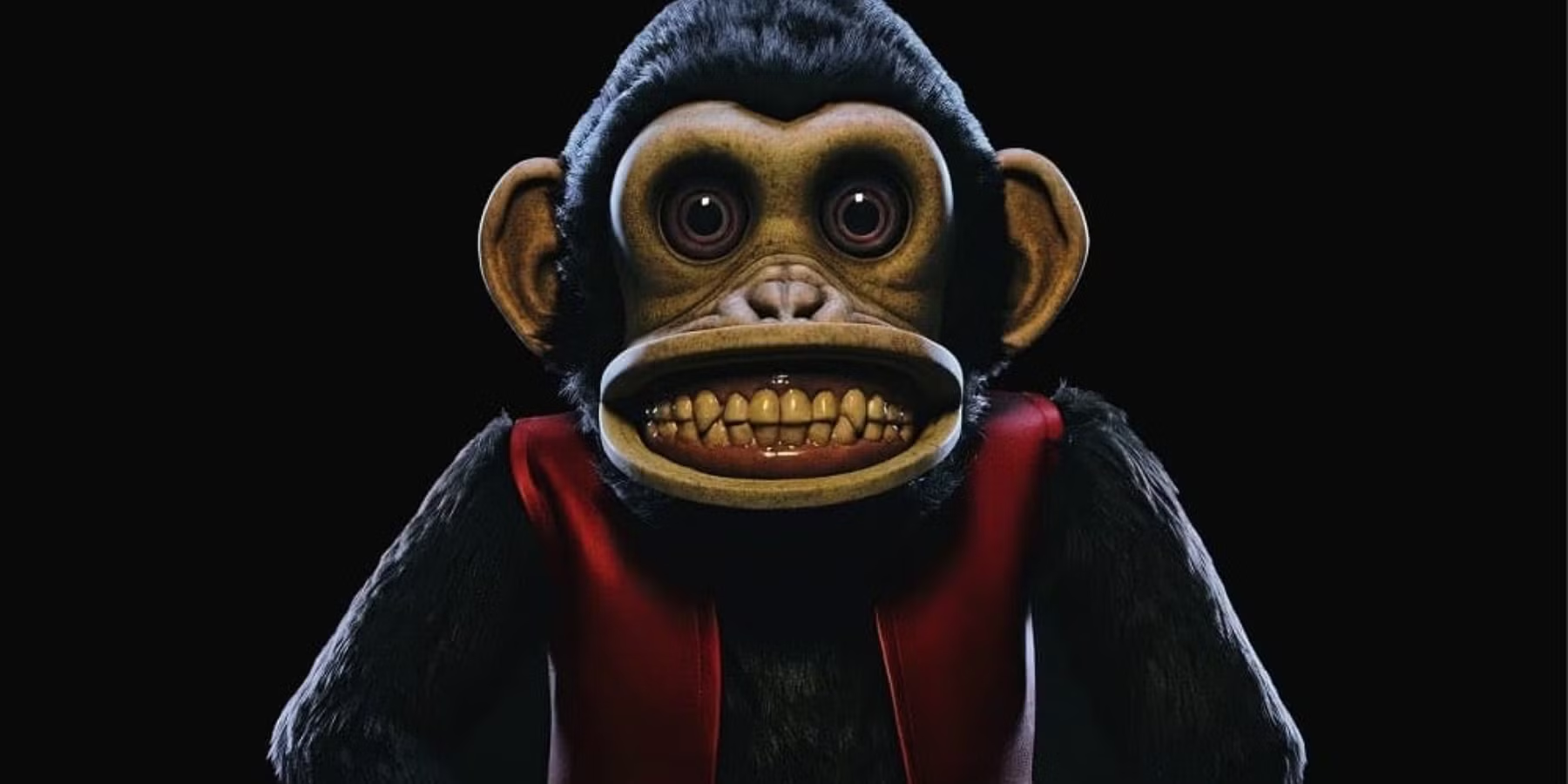
When you’re smiling, the world smiles with you.
I usually start my horror reviews with some version of:
“I don’t often watch horror films, but when I do…”
I told myself I wouldn’t do that this time. I was going to introduce The Monkey with something clever, something thoughtful, something insightful. I workshopped this for nearly half an hour, determined to break my self-imposed pattern and dazzle you, the reader.
Here’s what I came up with:
I don’t often watch horror movies, but when I do…I like to do it with a smile on my face.
Sorry…best I could do.
But it’s not just comedy I need. I also enjoy irony, wrath, and comeuppance. I have a soft spot for the killer toy genre, but not when it leans into vaudeville. Child’s Play is beloved, but never truly grabbed me, because the idea of a doll hosting a human spirit doesn’t scare me. The idea of a doll holding all the agency — so the protagonist might as well be fighting God — that is the thing that makes me uneasy.

Gets me positively sideways.
The Monkey, directed by Osgood Perkins and adapted from Stephen King’s short story of the same name, blends this premise with something I also have discovered I love in my horror:
Ritual.
Freddy Krueger’s stalking and taunting are often the best part of the A Nightmare on Elm Street experience. Every Hellraiser has Pinhead dragging victims through irony and spiky chains before dispatching them. The best Final Destination entries give us death as a visible Rube Goldberg machine — a terrifying timepiece of inevitability. Perkins’ film brings all that to the table, and spreads it like peanut butter over something still darker:
The slow burn of intergenerational trauma.
I was already sucked in by the concept, but I became all-in when Petey Shelburn (Adam Scott) walked into a dockside pawn shop carrying the titular toy. Few actors today can embody the afflicted everyman like Scott, so it’s natural to breathe easy when you see him.
Don’t, though, because the effects of his actions echo horrifically through the story. Petey’s trying to return the Monkey to the shop where, for unclear reasons, he bought it, and in under two minutes, we’ve confirmed why:
It’s deeply, hilariously cursed.

You have to see the whole scene. Trust me, it’s deeply hilarious.
The toy is a variant on the classic cymbal-banging chimp, but this one straddles a drum and wields a pair of drumsticks. When you wind the key in its back, it performs a jaunty little routine: raising and lowering its arms, spinning one stick, and finally bringing both down on the drum. That’s when people die — and always horribly. Whoever turns the key remains unharmed but becomes complicit in the fate of whoever the Monkey chooses to target.
It is ritual as performance, and it is hypnotically nasty.
Years later, Petey has inexplicably vanished, leaving his estranged wife Lois (Tatiana Maslany) and twin sons Bill and Hal (Christian Convery) to wrestle with their feelings of betrayal and anger. Lois, overwhelmed and likely self-medicating, keeps the household running through an indifferent haze. Meanwhile, Bill and Hal’s relationship is built on abuse and submission — Bill berates and exploits his (technically) younger twin, while Hal, too gentle to fight back, absorbs it all.
Make no mistake, the Shelburn family is already living under a curse.
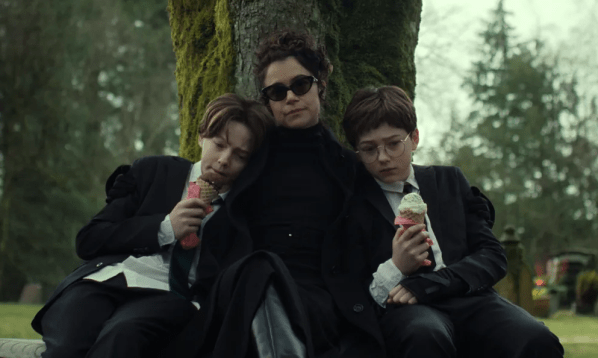
Of course, a curse with ice cream beats one without it.
The one thing all three share is resentment toward Petey, though both boys remain fascinated by his former career as an airline pilot. It’s during one of these sessions, digging through their father’s old belongings, that Hal finds the Monkey. When the boys decide to turn the key, it marks the onset of a new and more terrible chapter. Then one of them makes a fateful decision, using the Monkey in a way that changes — and darkens — their lives forever.
As more people die, Hal discovers that the Monkey is more than just cursed. It displays almost sentient malice, targeting those closest to whoever turns the key. If you’re wondering why they keep turning it, even as it causes tragedy, this is central to what drives the brothers apart. Hal eventually tries to dispose of it for good, and for decades, life seemingly returns to normal.
But the damage is done, and the brothers remain alienated for years. Then, naturally, the Monkey returns — and the real story begins.
It’s worth pausing to call out Convery, who plays the young versions of Hal and Bill. Convery gives Bill just enough alpha smarm to make him a believable heel without obscuring his vulnerability. And he inhabits Hal, who is nothing but vulnerability, with quiet strength and grace beyond his years. It’s a solid performance in a film that didn’t require it, but is all the better for it.

Same guy…ACTING!
The adult brothers are played by Theo James, perhaps best known for the Divergent films and a memorable stint on The White Lotus. His work here is all subtlety, stoically holding the screen as deaths around him grow increasingly spectacular (and darkly funny). The film keeps the adult brothers apart for much of its runtime, allowing James to focus less on physical differentiation and more on showing how the brothers have deteriorated internally.
Everyone gets an assist from Perkins and cinematographer Nico Aguilar, whose combined vision grants the camera a supernatural sense of consciousness. The plastic primate itself does not speak or emote — but you get the feeling it knows shit, and that you, as the viewer, might at times be indirectly viewing bits of the story through its malignant gaze. The film’s confident use of intimate angles, selective focus, and visual sleight of hand gives it a clear sense of character, elevating the experience and making a familiar premise feel distinct.
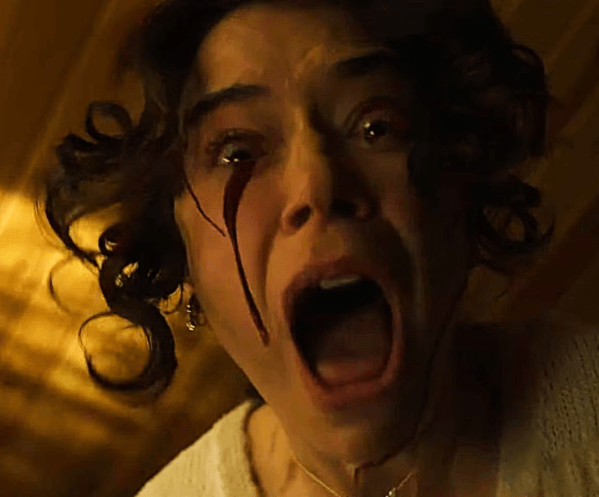
And, also, this.
I’m not trying to oversell The Monkey. It’s not revolutionary, and it didn’t change my life. But I had a lot of fun with it — it exceeded my expectations and put an ever-lovin’ goddamn smile on my face. Does it feel slightly inhuman to say that about a movie where people are facially impaled, physically exploded, and pulled apart like big meaty balls of yarn?
Yes.
But also no, because the fetishization of violence and cruelty seems to amuse us all on some level. Perhaps this is the part that makes us smile.
Perhaps it’s a built-in failing of humanity.
And perhaps it’s why the Monkey grins.
The Monkey is available on Amazon Prime Video and Apple TV.
Categories

Bruce Hall View All
“When some wild-eyed, eight-foot-tall maniac grabs your neck, taps the back of your favorite head up against the barroom wall, and he looks you crooked in the eye and he asks you if ya paid your dues, you just stare that big sucker right back in the eye, and you remember what ol' Bruce Hall always says at a time like that: "Have ya paid your dues, Bruce?" "Yes sir, the check is in the mail."
 CRITICULT - Telling you what's up since 2003.