
Arthur (1981)

This looks like a movie that wants to talk about alcoholism.
The first sound we hear after Christopher Cross’s wistful title ballad isn’t dialogue or score—it’s laughter. A high-pitched cackle echoes from the backseat of a golden Rolls-Royce, piercing the night as sharply as this grand and fabulous vehicle cuts through Manhattan. The car’s passenger is in no way worthy of this mode of transportation, for he is Arthur Bach (Dudley Moore), New York City’s most notorious new-money raconteur.
Tonight, Arthur is drunk, joyriding around Manhattan dressed like he’s going to the opera, needling his chauffeur about theology and hookers. Within minutes, he picks up an actual sex worker and treats her to dinner, joking with a kind of class-clown bravado more suited to a ninth grader than to a man who, well, gets driven around in a car that costs as much as a private jet.
For a film that ultimately wants us to love Arthur, Arthur spends an audacious amount of time showing us reasons we shouldn’t. He’s obnoxious, entitled, and emotionally unformed. Everyone who’s anyone in society knows who he is—Arthur is his money. But to everyone else, he must seem like an alien invader or a late-night talk show host in disguise, trying to catch people unaware on the street.
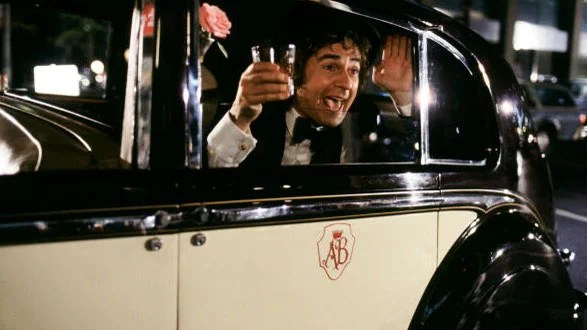
No dice, Fallon.
You know what? Let’s back up and start over.
Arthur Bach is heir to a nearly one-billion-dollar fortune. He’s a hard-drinking failson (with a heart of gold) who has bleakly accepted his lot in life as a rich drunken fool. His family doesn’t respect him, and his father can’t stand to be in the same room with him. His only true confidant is his lifelong manservant, Hobson (John Gielgud), who has raised Arthur since childhood and holds deeper, more complicated feelings for this disturbed little man than anyone else possibly could.
So—who the hell is this guy?
Is Arthur a whimsically carefree scamp who may or may not have chosen not to sleep with a prostitute, and instead gloated over his basketball–court–sized model train set? Or is he a deeply traumatized man-child who just wants to feel loved by the same people who only value him for his place on the family balance sheet?
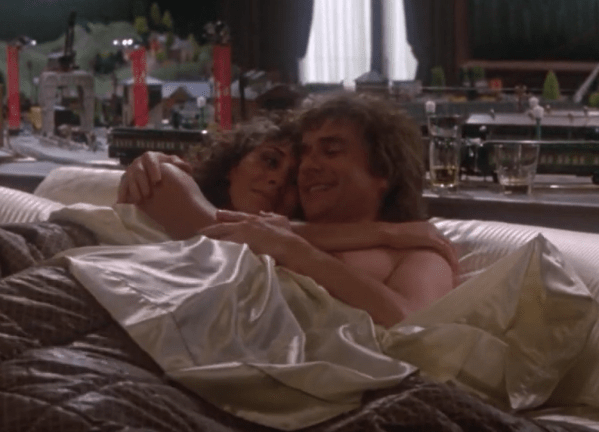
Both things can be true.
Arthur’s formidable grandmother, Martha (Geraldine Fitzgerald), sweeps into his life like a bird of prey, insisting that he finally get married. He’s well into his thirties, with no friends, no romantic prospects, and a list of personal shortcomings that begins with “alcohol-induced psychosis.”
Deemed unfit to inherit the family fortune, Arthur is told he must marry Susan Johnson (Jill Eikenberry), the eldest daughter of a rival financial dynasty.Their union would constitute not just a holy matrimony in the eyes of God but—far more importantly—a sublime corporate merger in the eyes of the SEC.
Susan actually seems…not unpleasant…and she makes no bones about what she knows the marriage to be. Arthur could, quite literally, have it both ways. And while he agrees to the nuptials, there’s no doubt—inside or outside the story—that his heart isn’t in it.
Because, you see, Arthur Bach is a closet romantic.
He is both the whimsically carefree scamp and the deeply wounded adolescent, and his immaturity runs deep enough to include a childish idea of love itself. He doesn’t want the sublime corporate merger—he wants someone who will adore him without expecting him to earn it. Just unconditional devotion, delivered on a silver tray—like everything else.
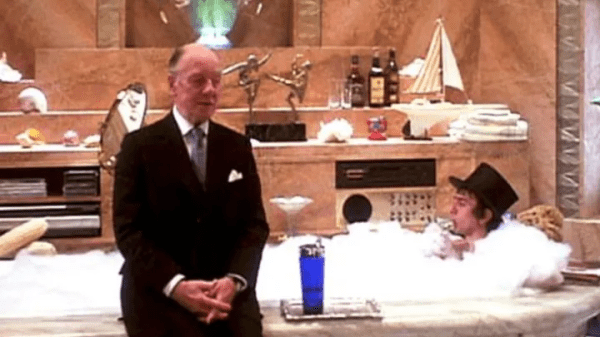
Your breakfast martinis, sir.
Arthur has lived his entire life on the family dime. He’s never had to fend for himself; he’s never even been asked to. And with no real model for adulthood, there’s little reason to believe he’ll ever get there. Doesn’t sound like a comedy, does it? Initially, it wasn’t, as James Caan was originally sought to star in a much darker story.
But this isn’t that version.
We’re not here to watch a man wrestle with toxic relationships or—God forbid—actively confront his addiction. While there are moments of real sincerity, Arthur mostly plays what could have been a grim character study for honest laughs. And in this reimagined form, it somehow works even better. This film favors the journey over the destination, offering us a cast of static caricatures who never grow or change—but, somehow, never need to.
It’s a neat trick. And every time I watch Arthur, I notice it, and then it whiskes me into 1980s New York.

Those aren’t lights on the bridge. That’s ALL cocaine.
Out of the gate, the film lets its cinematography and soundtrack do the heavy lifting. It glides along on mood and movement, letting the golden haze of city lights and the silky warmth of Christopher Cross’s voice lull us into a false sense of security. The spell never entirely breaks, but behind the soft rock gloss is a character who is profoundly adrift. Arthur isn’t merely eccentric; he’s been hollowed out by neglect.
His laughter echoes from a void, and his drunken, preteen-style exploits mask the fact that this poor creature has never been allowed to grow up.
But the story relies less on logical plot mechanics than on honest, deeply funny performances—rooted not in what we see, but in the deeply personal drama that could be onscreen, but isn’t. When Arthur meets Liza Minnelli, at the height of her powers Linda Marolla (Liza Minnelli), the match is struck and what seemed like an off-kilter farce becomes cinematic alchemy, with just a dusting of pathos.
Liza Linda is introduced as a department store thief when Arthur and Hobson catch her pilfering a necktie from an upscale clothier. Arthur is enchanted by the intervention of Chance in his otherwise inviolable world. It also doesn’t hurt that “Chance” looks like Liza Minnelli, at the height of her powers Linda Marolla.
Against Hobson’s advice, Arthur confronts her outside and is charmed by her earnest, no-nonsense demeanor. She was stealing a tie for her father’s birthday and—well, I guess she just needed that tie. But she seems sincere in a way Arthur almost never encounters. And Arthur, having no inherent sense of right and wrong, is positively enchanted.
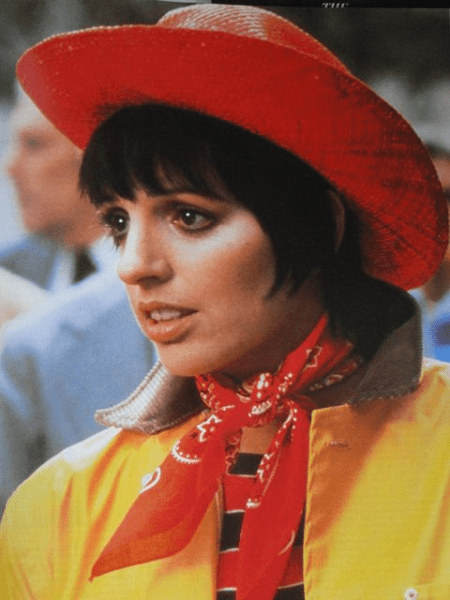
It’s not the hat, but the scarf that brings it all together.
They begin an unlikely courtship, ultimately leading to Arthur’s family threatening to cut him off. But the stakes aren’t material—they’re emotional. The film doesn’t ask us to worry that Arthur will starve, or if Linda will have to continue pilfering clothing accessories for her father. This is a 97 minute film; the question isn’t how it’s going to end or even when.
The question is how will you feel when the credits roll?
For me, Arthur goes down like the time, in my twenties, when I discovered brunch and prosecco on the same day. It was a version of breakfast and champagne that was perfectly fine to enjoy at any time of day.
A guilty pleasure.

Tee hee hee – we’re day-drinking!
Dudley Moore plays Arthur with off-kilter elegance: funny, flawed, small in stature but enormous in charm. He leans into Arthur’s eccentricity early, playing him as the crown prince of arrested development. His penthouse is a gilded nursery, and his life a series of indulgences without consequence. Minnelli is radiant, giving Linda grit and warmth without tipping into manic pixie cliché. Her chemistry with Moore is offbeat but also positively undeniable. They meet as opposites and move toward each other with real emotional weight.
She’s brash, poor, and fearless. He’s brash, rich, and filled with existential dread.
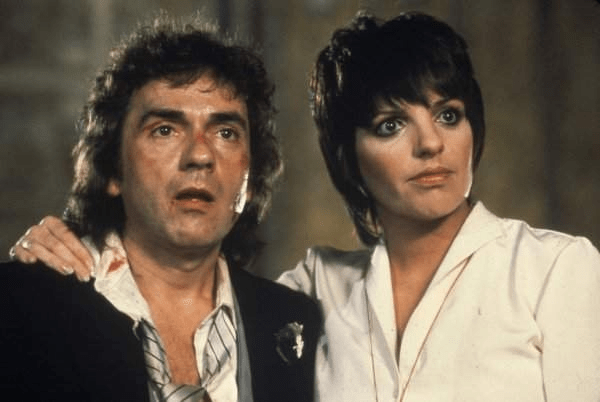
Like so.
It’s clear Linda can’t fix Arthur—part of that “dread” is his own nagging fear that he can’t be fixed. And while in real life, he would absolutely have to stop drinking to find happiness, this film not only doesn’t insist on it, it doesn’t even mention it. Other characters often implore Arthur to “grow up,” but no one ever begs him to stop drinking. His alcoholism is treated as an eccentricity rather than a crisis. A comic tick rather than a symptom of something larger.
But it was a different time, and this is an uncomplicated narrative – Linda simply offers Arthur a glimpse of something better. She believes in him even though she probably shouldn’t. He attempts to rise to her expectations even though he probably can’t. And despite being occasionally unsettled, we never feel truly threatened, because while there is genuine sentiment in the story, it remains a romantic comedy through and through.
It asks us to believe in charm over change, in possibility over plausibility.
And when the music swells one last time, we believe it.
If you DID get caught between the moon and New York City, my opinion is the best that you could do is fall to your death.
But Arthur would still like you to know – it’s okay to laugh, even when you feel lost.
Categories

Bruce Hall View All
“When some wild-eyed, eight-foot-tall maniac grabs your neck, taps the back of your favorite head up against the barroom wall, and he looks you crooked in the eye and he asks you if ya paid your dues, you just stare that big sucker right back in the eye, and you remember what ol' Bruce Hall always says at a time like that: "Have ya paid your dues, Bruce?" "Yes sir, the check is in the mail."
 CRITICULT - Telling you what's up since 2003.