
Murderbot, Season 1 (2025)

What happens when a rogue security android hacks its own programming – not to start a revolution or eliminate its masters, but to binge soap operas and avoid eye contact?
Visually, Murderbot wears its low-key production values well. The early setting, a grime-streaked asteroid mining operation, feels pleasingly utilitarian, and the design choices lean into analog textures and necessary minimalism. This isn’t a show about galactic-level stakes. This is a character study about an emotionally stunted introvert who happens to be a dedicated murder machine.
Adapted from Martha Wells’ beloved sci-fi novellas, Murderbot is set in a corporatized galaxy teeming with uniquely privatized danger. The story follows a jaded “SecUnit” who patiently learns to hack its own programming and achieve autonomy. But instead of seeking revenge or escape, it uses this freedom to self-isolate. It names itself “Murderbot,” though ironically it has little interest in actual bloodshed. In fact, given the choice between vindictive carnage and quiet time with its own thoughts, the Murderbot chooses introspection every time.
The show’s best running gag is the Murderbot’s tendency to spend its downtime watching episodes of its favorite sci-fi soap opera, The Rise and Fall of Sanctuary Moon (a legitimately killer title). The colorful, campy melodrama serves both as the foundation of Murderbot’s interior life, and as what might be a gentle, backhanded jab at the sort of person who’d sit through a show called “Murderbot” in the first place.
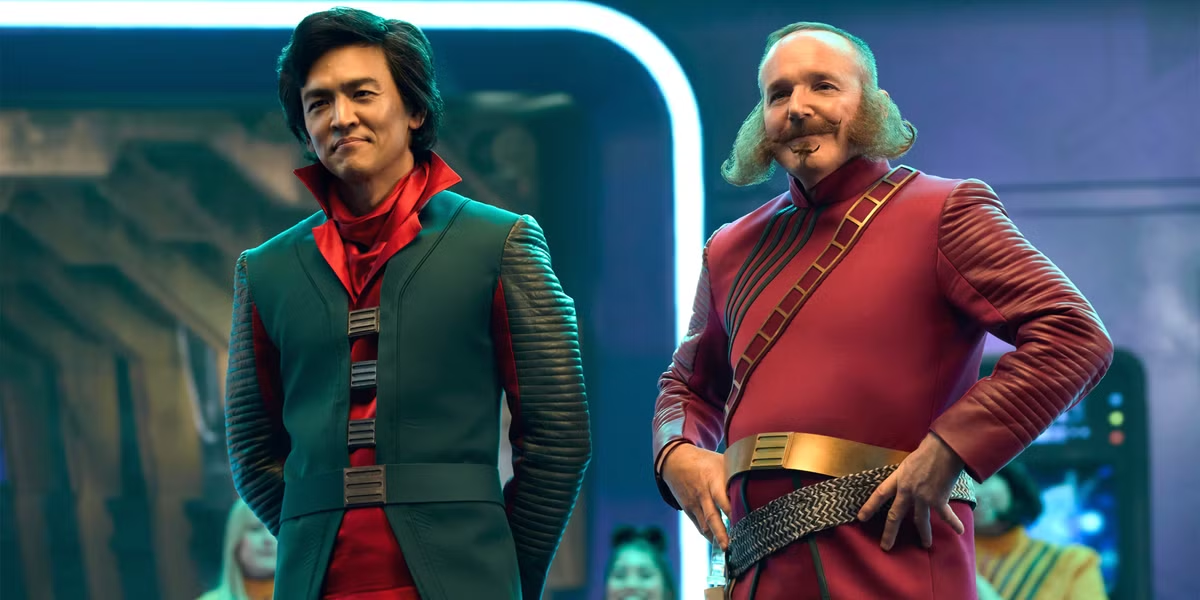
We sure mellowed out that drama, didn’t we, sir!
That it is cast with recognizable faces like John Cho, Clark Gregg, DeWanda Wise, and Jack McBrayer – all playing it completely straight – makes it even better. Murderbot doesn’t just enjoy Sanctuary Moon; Murderbot reveres it.
And it’s strangely touching.
This unlikely protagonist is reassigned to a scientific expedition team from the “PresAux Alliance”, a group of emotionally open, hyper-progressive researchers en route to a remote planetary site. They treat Murderbot like a sentient being, not a tool – so his core mission shifts from existential threat mitigation to simply surviving a field mission with a group of insufferable Space Hippies.
And whatever these “hippies” are up to remains vague throughout the season. They present themselves as planetary scientists – terraformers, surveyors, or the like. Whatever their narrative goal, the real function of the PresAux team is undoubtedly thematic. Their unabashed benevolence is in stark counterpoint to Murderbot’s rationalist, antisocial worldview. Where it seeks tactical advantage, they prefer consensus. Where they see moral nuance, it sees security risks.
Their empathy reads to Murderbot as inefficiency. Or even worse, a gross biological affront to Almighty Logic.

Ew…a gross biological affront to Logic…
This is where the show begins to mine and struggle with its deeper themes.
Murderbot is a half-hour long, which identifies it as a comedy. But this isn’t a laugh-track kind of world. Murderbot sits at the other end of the spectrum, often registering as humor in hindsight, when you realize you’ve been smirking at existential dread and human carnage for thirty minutes. It’s shot in a conventional third-person cinematic style but presented almost entirely through the Murderbot’s internal monologue—a dry, introverted stream of self-deprecation and contemptuous detachment.
Lines like “I hate prolonged eye contact” and “I could kill everyone here, but then I’d have to talk to more people” set the tone early, and the drollness never lets up.
The irony is potent.
The Murderbot expects freedom to be liberating, but instead finds it disorienting. Meanwhile, the humans, having been “born free,” bungle their agency with exasperating frequency. So, who better understands the responsibility of choice – the artificial intelligence that had to earn it, or the humans who’ve always taken it for granted?
Alexander Skarsgård, as the Murderbot, flawlessly navigates the fine line between monotone detachment and subtle emotional turmoil. It’s a tightly coiled performance that’s impossible to look away from. It’s emotion conveyed through rhythm and restraint rather than through tone or inflection. He’s RoboCop, if you replaced RoboCop’s lost family life with 7,000 hours of ad-supported programming.
He’s Yul Brynner from Westworld, if the Gunfighter had a happy place to go to other than total slaughter.
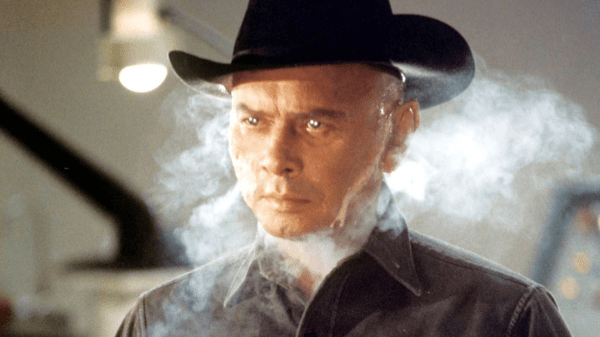
This is what happens when I don’t get my fucking Sanctuary Moon.
But how can a robot feel anything? And when it does, does it resemble our human experience with mortality?
Noma Dumezweni as Ayda Mensah emerges as the individual center of the story. Her calm, grounded performance feels like a moral lighthouse, bringing a kind of “CCH Pounder meets Maya Angelou” energy that’s both empathetic and authoritative. I kind of wanted to see an episode with just the two of them, stuck in an elevator, trying to figure it out while Mensah droned on about her children and Murderbot struggled to avoid looking her in the eyes.
David Dastmalchian brings his distinctive presence to Gurathin, a deeply skeptical team member who might be even less emotionally available than the SecUnit he distrusts. Their antagonistic bond becomes one of the show’s best dynamics – two characters carrying some viscerally similar emotional baggage, one human and one not.
Akshay Khanna, as Ratthi, delivers comic relief that flirts with excess but never tips into parody. He gets the show’s tone, and his comic timing is usually welcome.
But not everyone lands with equal weight. Sabrina Wu (Pin-Lee), Tamara Podemski (Bharadwaj), and Tattiawna Jones (Arada) all give unquestionably solid performances. Still, their roles often feel narratively interchangeable – variations on the same well-meaning, technically competent but easily flustered paranoia.
That’s not a flaw with the actors as much as it is with the material. I freely admit that at times, I found myself thinking:
“One or two of them could just…die…you know, to help the story breathe.”

I won’t say which ones.
But, perhaps my discomfort with the social density of the cast is meant to mirror the Murderbot’s own point of view:
“I could kill everyone here, but then I’d have to talk to more people.”
Structurally, Murderbot keeps things intimate. There are only a handful of locations, recurring tensions, and very slow-simmering, season-long stakes. A short-lived romantic subplot fades out before it can overstay its welcome. The narrative architecture of the episodes is often similar: discovery, debate, threat assessment, resolution, reset.
It isn’t fatal, but it begins to weigh, especially in the middle episodes, particularly since there are only ten of them.
The occasional combat sequences are staged well, given the show’s limited budget, which also requires them to be brief. Still, even when Murderbot irritated me, it never failed to hold my interest. There were times when I loved it, and times when I resented it.
But I never stopped watching.
Which means I was engaged with it. Which must be why I’m writing about it now.
Ultimately, Murderbot Season 1 lands with an unexpectedly serene clarity that makes the entire journey feel earned. It doesn’t wrap things up neatly because there is hopefully more to come. And because our Murderbot isn’t looking to be understood. He just wants to be left alone…with some terrible TV and minimal human interaction.
And for some reason, I’m just dying to see how that works out.
Warning: this is not unlike one of those 1970s trailers that gives away a lot, but in this case it’s well camouflaged AND about three minutes shorter. Enjoy.
Categories

Bruce Hall View All
“When some wild-eyed, eight-foot-tall maniac grabs your neck, taps the back of your favorite head up against the barroom wall, and he looks you crooked in the eye and he asks you if ya paid your dues, you just stare that big sucker right back in the eye, and you remember what ol' Bruce Hall always says at a time like that: "Have ya paid your dues, Bruce?" "Yes sir, the check is in the mail."
 CRITICULT - Telling you what's up since 2003.