
Dazed and Confused (1993)
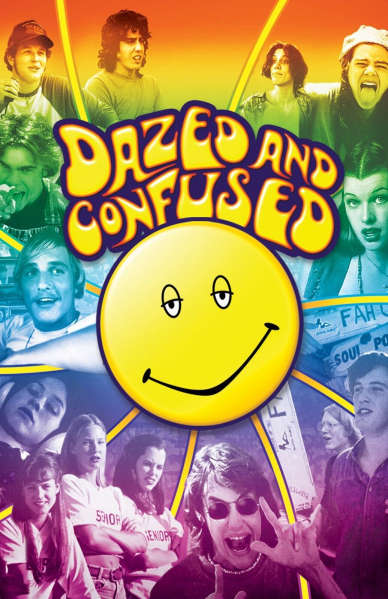
That dorm room wall of yours is looking awfully bare.
Some movies tell you what to think. Others tell you what to feel. Dazed and Confused doesn’t really try to do either. Instead, it holds up a mirror — a blurry, humid, beer-streaked mirror—and asks:
Do you see yourself in this?
Taking place over the last day of school in 1976, Dazed and Confused doesn’t bother with a traditional plot. It follows a loose collection of students — seniors, freshmen, and everyone in between — as they drift through hazing rituals, pickup games, parties, and aimless cruising. The day culminates at a backwoods keg party that could just as easily have taken place in an abandoned warehouse, a remote cornfield, or a socially negligent family basement.
But there’s no quest to complete, and no singular triumph or tragedy. It’s a cross-section of young lives momentarily colliding in that strange, suspended moment between obligation and freedom.
Writer-director Richard Linklater isn’t trying to tell a grand coming-of-age story. He’s simply observing, almost anthropologically, how various personalities react to a shared, transitional experience. In that sense, the film feels less like a narrative and more like a particularly vivid memory — the kind that grows fuzzier and more mythologized the older you get.

This fall, on the CW…
At the center of this portrait are characters like football star Randall “Pink” Floyd (Jason London), torn between loyalty to his team and loyalty to himself; Mitch Kramer (Wiley Wiggins), a freshman trying to survive his first tastes of ritual humiliation AND independence; and Mike (Adam Goldberg), Cynthia (Marissa Ribisi), and Tony (Anthony Rapp), a trio of self-styled outsiders eager to usher in change, even if they’re not sure what that means yet.
Hovering at the edge are future stars Ben Affleck (O’Bannion) and Parker Posey (Darla), playing the male and female avatars of institutional cruelty.

And, evidently, aggravated assault.
Most of these characters should resemble someone you remember from high school. Each faces a different version of the same question we all do at some point: how much do you bend to fit into the world, and how much do you risk by standing apart from it? It’s a big question, but the intense significance teenagers assign to relatively ordinary events is a natural result of limited life experience, and looking back, Dazed and Confused makes that realization feel bittersweet.
When you’re young, your world is small, so every new experience feels huge simply because there’s no broader scale of reference. A minor party, a kiss, a fight, or a bad day at school can feel life-changing because it’s unfolding inside a compressed emotional universe. Dazed and Confused captures that sensation perfectly. It shows us a night that, in the grand scheme of life, probably won’t come to mean much — but it feels like a portal into a whole new world for the characters living it.
And didn’t your graduation night feel that way to you?
Linklater captures the emotional truth of youth, preserved in amber and held up to the light of unrestrained nostalgia. But if you think the story is building toward some grand dramatic arc, it’s not. These characters don’t change dramatically, nor do they push the story forward through big decisions. What we’re witnessing is exposure, not evolution.
It’s as if we’ve photobombed a significant night in their lives, then slipped away long before the consequences begin to settle.
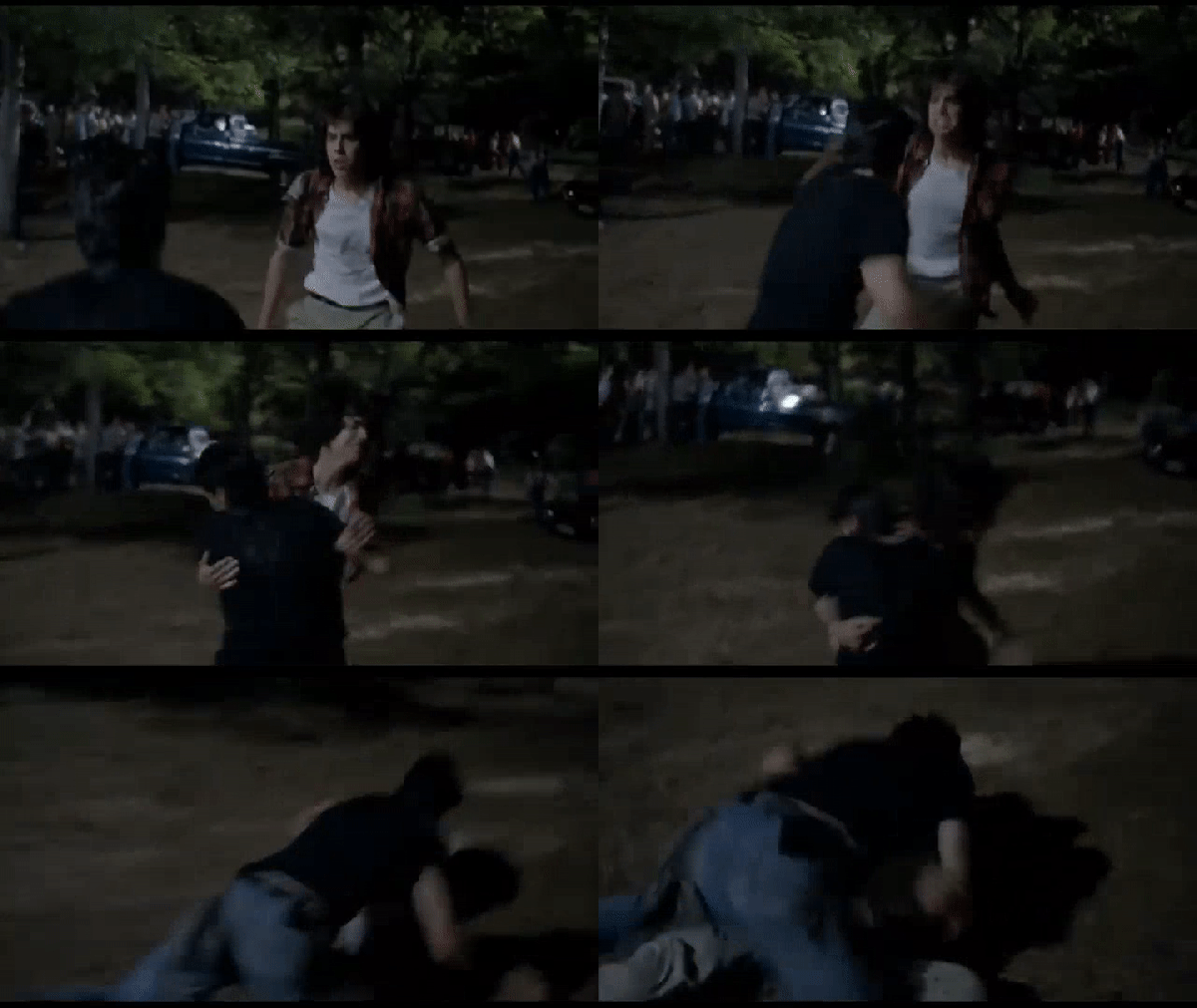
Pictured: Consequences
Because the story takes place at a very specific place in time, you occasionally feel the weight of the American Bicentennial in the background — a national celebration some of the kids use as a convenient excuse to stoke their distrust of authority. It’s a familiar pattern: every generation finds its own symbols to reject, its own reasons to justify stepping outside the lines. Whether it’s political scandals, economic crashes, or whatever comes next, the instinct is the same — push back first, sort out the logic later.
Dazed and Confused taps into a near-universal memory for anyone who’s been through high school: the rigid tribes we form, and the fleeting moments when those divisions dissolve. For one night, the jocks, stoners, nerds, and outsiders drift between worlds, reminded — if only briefly — how much they really have in common. Linklater doesn’t romanticize rebellion so much as he captures the fragile relief of simply belonging, before life inevitably forces us all back into place.
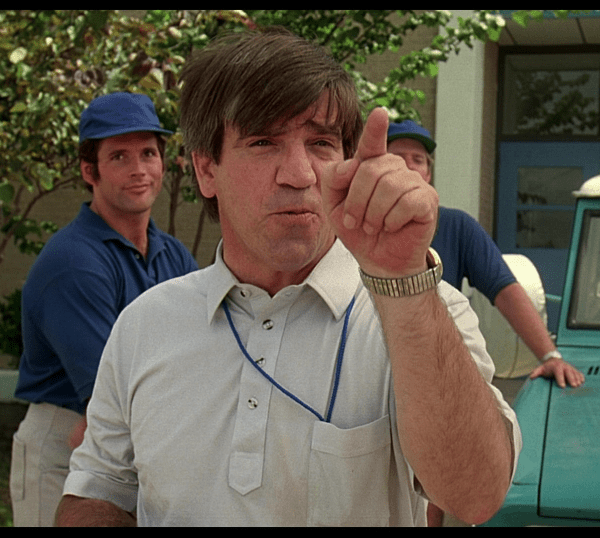
Or, maybe Coach Pointerson does.
Despite its rampant sentimentalization, Dazed and Confused still treats all its characters with essential empathy. Authority figures aren’t monsters; they’re just worn out — and more than a little amused by the gravity with which children infuse these small windows of time. And rebellious kids aren’t necessarily heroes; they’re just feeling their way forward in a rapidly evolving world, more full of certainty than clarity.
Even the bullies — O’Bannion and Darla — aren’t drawn as simple caricatures. Their cruelty is compensation for an unearned sense of power they can already feel slipping away.
You can’t talk about Dazed and Confused without talking about Wooderson, the laid-back local legend still orbiting the high school scene, well into his twenties. He begins as a familiar archetype, but Matthew McConaughey turns him into something more lasting and ambiguous. Most of his lines were improvised, and his lithe physicality makes the character feel less like a punchline and more like someone you might actually know (especially if there happens to be a trailer park in your ZIP code).

Gas, grass or ass, baby!
Wooderson’s charisma softens the darker implications baked into his aura, especially when viewed through a modern lens. There was a “Wooderson” in my high school — a walking suburban myth who delighted in exposing underage kids to alcohol, drugs, and pornography while often getting a little too friendly with the female underclassmen. Wooderson never quite crosses that line (on-screen anyway), but it’s not hard to envision — or to imagine his potential future stint in state prison.
Within the film’s context, however, that affable clash between Legend and Lothario makes Wooderson memorable long after the credits roll.
That may be what I admire most about Dazed and Confused: it refuses to idealize anyone, and it doesn’t attempt to define a “correct” or “incorrect” path. Rather than declaring a winner, it simply offers a glimpse of life in the moments just before the future asserts itself. Before the gravity of adulthood starts closing doors you didn’t even know were open. This is a snapshot of American youth, not a manual for life, and appreciating that means understanding both the beauty and the austerity of the moment it’s trying to define.
Categories

Bruce Hall View All
“When some wild-eyed, eight-foot-tall maniac grabs your neck, taps the back of your favorite head up against the barroom wall, and he looks you crooked in the eye and he asks you if ya paid your dues, you just stare that big sucker right back in the eye, and you remember what ol' Bruce Hall always says at a time like that: "Have ya paid your dues, Bruce?" "Yes sir, the check is in the mail."
 CRITICULT - Telling you what's up since 2003.