
Unbroken (2014)
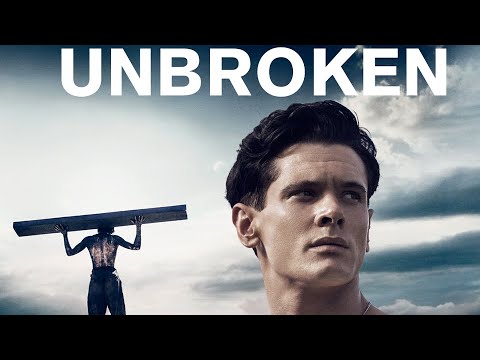
Unbroken begins with a long, patient shot of a dusky sky, the camera panning slowly — almost too slowly — until a handful of warplanes begin to emerge, one by one, from the haze. It’s an eerie moment of real cinematic clarity, full of beauty and foreboding. The planes don’t roar into view; they slowly wink into existence. It’s the first and best indication that this is not a war movie in the traditional sense. This is a film about stillness, anticipation, and about the long, quiet spaces between acts of endurance.
And that first shot tells you something else, too: Unbroken is going to ask for your patience.
Directed by Angelina Jolie and adapted from Laura Hillenbrand’s biography of airman Louis Zamperini (Jack O’Connell), the film tells the true story of an Olympic athlete turned WWII bombardier who survives a plane crash, drifts at sea, and endures torment in Japanese POW camps. The story is astonishing, but here’s the paradox: knowing Zamperini survives — the title tells you as much — subtly blunts the dramatic tension. That’s a hard task for a filmmaker to keep engaging. And it’s why when I see “based on a true story” attached to a film, I hesitate.
We all know how this story ends, so how are we going to get there? Will it be maudlin, self-serving Oscar bait, or will it be an engaging story that connects us to the life behind the legend?
Thankfully, Unbroken is not about whether its hero survives, but how.
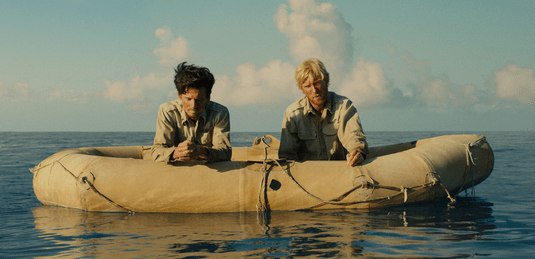
Here’s a hint.
To Jolie’s credit, she leans into tone and atmosphere rather than brute force dramatics. Working with a script touched by the Coen brothers and cinematography by Roger Deakins, she builds a world that’s stunning to look at but remains emotionally grounded. The firefight that opens the story isn’t enormous or surprising — we know we’re in combat planes — but it’s framed through the tight lens of Zamperini’s bomber. It’s hypnotic and chaotic, full of long interior shots of men shouting, swiveling, working. One haunting image of a Japanese Zero spiraling into the ocean, seen through a gash in the fuselage, captures both the beauty and horror of war in a single frame.
And just when you think this must be the turning point — the fateful crash that reshapes his life — it’s not. It’s just another day at war. That’s part of the film’s quiet effectiveness: it’s not a story about one extraordinary event, but about what happens when a person is tested again and again.
O’Connell plays Zamperini with a performance that’s all restraint and physical commitment. His “Zamp” isn’t a quip-ready hero or a brooding antihero. He’s a young man learning, through degrees, how much he can take. Raised in a strict but loving Italian-American family, bullied, dismissed by authority, stung by bigotry, he finds purpose through track and field. The subplot about his Olympic bid isn’t the centerpiece of the story but it’s essential.
He didn’t expect to medal; he simply wanted to compete. He took pride in having shown up well when many thought he shouldn’t be there at all. He did his best, and wore it with pride.
That becomes a theme for his life.
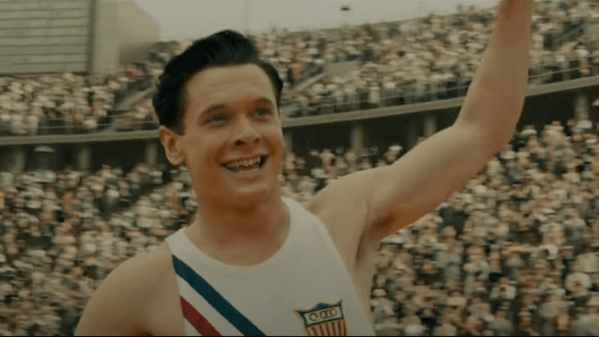
This is the face of a man who technically LOST.
Later, that Olympic accomplishment becomes a weapon used against him. As a prisoner of war, his fame paints a target on his back. In particular, he draws the attention of a prison commander named Watanabe — “The Bird” — played with chilling unpredictability by Japanese musician Miyavi. Bird is a fascinating presence: elegant, effete, deeply insecure, and cruel in ways that seem more performative than strategic. He doesn’t want to kill Zamperini. He wants to break him — because in doing so, he believes he can elevate himself.
We’re told early on that Bird was denied a promotion, and later he falsely claims to have received one. But when we next see him, it’s at an even worse prison camp. His supposed “promotion” feels more like a lateral move into exile than an advancement. Bird is implied to be a man clinging to the illusion of power, desperate to define himself through dominance. His obsession with Zamperini is pathetic and terrifying – not because it’s about control, but because it’s about envy.
The American Olympian is everything he wishes he could be: modest, composed, and durable.

And, maybe, a little easy on the eyes.
In this dynamic, the film quietly asks a question about identity and worth. One man, kicked around by the system, chose to better himself — inspired by his family and, most of all, his brother Pete (Alex Russell). The other, denied recognition, chose to punish the world around him. This doesn’t excuse the Bird — MacArthur himself wanted him tried after the war. But what strikes me about this character — and about petty people in general — is that the ability to be better was likely always within him, too.
Both sides in war tell themselves that the other is evil – but the option to behave with honor and dignity is, at all times, available to everyone. Perhaps this is why the real-life Bird refused to meet Zamperini after the war. To look him in the eye would have been to confront everything he failed to become.
Unbroken doesn’t editorialize this. It simply shows the contrast — and lets it hang there.
The film’s score, by Alexandre Desplat, deserves mention for its subtlety. Unlike some war dramas that drench every moment in emotional cues, the music here is restrained, occasionally lyrical, and most powerful when it holds back. The silence of the raft scenes, the clatter of forced labor, the hush of a prisoner holding a plank over his head while the sun bears down — these moments are allowed to breathe.
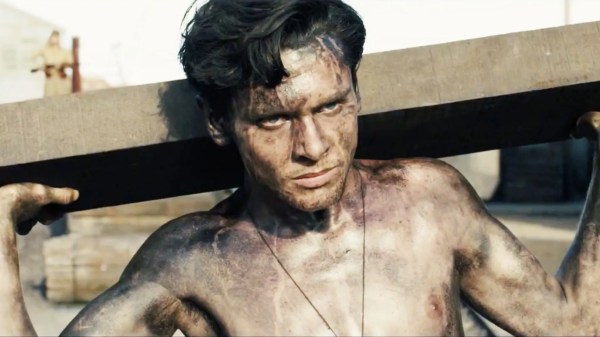
As they must.
That moment, in particular — Zamperini’s refusal to collapse under the Bird’s punishment — is the emotional and symbolic apex of the film. He holds a wooden beam above his head until it seems his body will fail him – but it doesn’t. He never drops it. And in that stillness, the real defeat happens: not to him, but to his captor. That’s when you understand the full meaning of the title. He may be bloodied, imprisoned, humiliated — but he remains unbroken.
Make no mistake – Unbroken is a good film with noble intentions, but like most true stories, its narrative pales in comparison to the real life details. The filmmakers know how it ends, and so do we. So, it never quite surprises you emotionally the way it might were it fiction. But that’s a built-in challenge when adapting any biography. What matters is the narrative impact of the story. And here, Jolie does a fine job establishing mood, trust, and a visual storytelling style that communicates far more than the dialogue ever could.
Perhaps the most remarkable thing about Unbroken is that it never insists on heroism. It simply shows us. It lets the quiet moments speak – a boy watching his mother make gnocchi, a man sitting under the weight of punishment and refusing to fall, a prisoner choosing dignity over despair. The religious faith Louis came to fully embrace after the war isn’t central here — but you can see and feel its roots growing throughout the story.
Unbroken is not a film about action. It’s a film about persistence. It’s about the idea that the best version of ourselves is already within us. All we have to do is believe we can get there and, in the parlance of the film – understand that if we can take it, we can make it.
Categories

Bruce Hall View All
“When some wild-eyed, eight-foot-tall maniac grabs your neck, taps the back of your favorite head up against the barroom wall, and he looks you crooked in the eye and he asks you if ya paid your dues, you just stare that big sucker right back in the eye, and you remember what ol' Bruce Hall always says at a time like that: "Have ya paid your dues, Bruce?" "Yes sir, the check is in the mail."
 CRITICULT - Telling you what's up since 2003.