
The Dark Knight Rises (2012)

Now you have my permission to read….
Few films carry the weight of expectation that The Dark Knight Rises did. As the conclusion to a trilogy that reshaped how audiences thought about superhero films, it bore the impossible task of tying off grand themes, servicing beloved characters and a story that had grown darker and more complex with each entry. That’s a lot of heavy lifting, and this film definitely does not get the bar off the mat cleanly.
But maybe it wasn’t trying to.
At the time of its release, Rises was widely received as something that was good, but also deeply flawed. It was ambitious and technically bold, but overstuffed, occasionally inelegant, and structurally uneven. On a personal level, I’d anticipated it as much as everyone else, and found myself initially questioning whether or not I even liked it. But with distance, The Dark Knight Rises begins to feel less like a disappointing finale and more like a quietly radical statement, not about Batman, but about the psychology of myth.
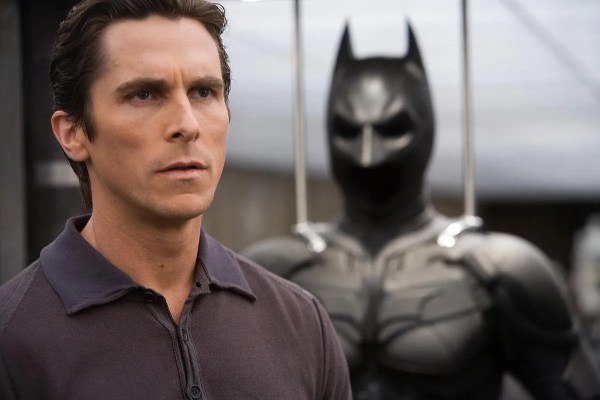
Wait, he’s HOW big??
This film brings the trilogy full circle in a way that’s easy to miss on first viewing. The villain of this story is Bane (an unrecognizable Tom Hardy), a classic Batman villain whose intimidating mask gives him a terrifying level of strength and endurance that Batman is unable to match. In the comics, Bane often plays second fiddle to more powerful villains but here, his motivations are not just opportunistic—they are inherited. What Gotham faces now is not a new threat, but the spiritual offspring of the thematic ideas planted way back in Batman Begins.
In Batman Begins, Bruce Wayne (Christian Bale) explicitly builds Batman as a symbolic weapon—a theatrical embodiment of fear. His logic is both strategic and emotional: if criminals fear the idea of Batman, then the man himself doesn’t always need to be present. It’s myth as a force multiplier. It’s grief channeled into something performative, meant to outlive his physical presence.
He makes the statement:
“As a man, I’m flesh and blood. I can be ignored, I can be destroyed. But as a symbol… I can be incorruptible. I can be everlasting.”
But that line doesn’t just launch the trilogy—it quietly dooms it.

Did I do that?
In The Dark Knight we’re introduced to The Joker (Heath Ledger), a figure who exists entirely outside the narrative spine of director Christopher Nolan’s trilogy. The Joker has no interest in ideology or legacy. He doesn’t challenge the symbol of Batman with a competing vision—he rejects the very premise that symbols matter at all. And in doing so, he exposes just how fragile Bruce’s carefully constructed myth truly is. By the time The Dark Knight Rises begins, Gotham’s police see Batman as a relic, the criminal underworld sees him as a ghost story, and the public sees him either as a disgraced vigilante or a martyr.
But more importantly Bane, our new antagonist, is the one person in the trilogy who truly understands the game Bruce is playing – and he isn’t impressed. Not only that, but Anne Hathaway’s Catwoman – an appealing iteration of the character who is starved for screen time here – presents as someone already familiar with Bane, and fully aware that Batman stands no chance of defeating him.

The mythology Bruce Wayne once embraced—the belief that fear could be shaped into purpose—has mutated in his absence. What began as a vow to terrify criminals has become a creed adopted by others, warped and re-weaponized – this time against the people of Gotham. So after a long disappearance, Batman returns to the mantle with a mixture of guilt, desperation, and fading clarity. And even as his actions alienate those closest to him, he must reckon with the fact that his personal narrative—his legend—was never as contained as he hoped.
Where the previous films explored fear, escalation, and moral compromise, Rises turns inward. It’s less interested in crime-fighting than in what happens when the stories we tell ourselves—about heroism, power, control—stop working. Gotham, like its protagonist, is tired. Ideals have become burdens. Legends have become lies. And the question that hangs over the film isn’t can the hero return, but should he?
Nolan presents us with a superhero world in which no one has actual powers—only convictions, obsessions, and wounds sharpened into tools. And in one of the film’s more emotionally exposed moments, a young police officer (Joseph Gordon-Levitt) confronts Wayne not with judgment, but recognition. He sees that beneath the mask is someone who has let his symbol define him. Whether consciously or not, this confrontation reveals the quiet argument running beneath the trilogy’s surface: that myth isn’t what saves people—it’s what blinds them to reality.
The more you believe in your own legend, the more danger you pose to yourself and to others.
This is clearest in how the story handles Batman’s legacy. Wayne’s first attempt to defeat Bane with Batman’s usual tricks – rage, force, theatrics – fall predictably (and brutally) short. The story beat of Bane breaking Batman’s back is borrowed from the comics for Rises, but it’s presented less as an act of physical destruction, ane more the symbolic collapse of a man who believed his legend could still protect him. This leads to some weak points in the back half of the film, as we’re asked to buy into a physical and psychological transformation in Wayne that seems undeserved within the film’s timeline.
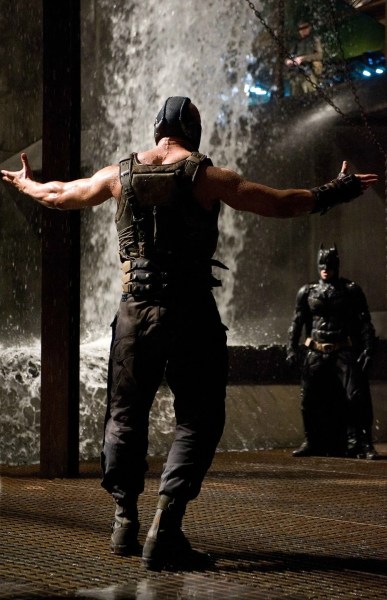
Come at me, bro!
The idea of Batman having a successor is also dangled in front of us. But rather than offering a triumphant torch-passing, the film dares to suggest that carrying the symbol forward might not be noble—it might be repetitive. Myth becomes a cycle: comforting, heroic, but ultimately unsustainable. And while the film gestures at closure, it also leaves us with a quietly unsettling possibility—that heroism, when inherited uncritically, might not save anyone at all.
As I said before, The Dark Knight Rises strains under the weight of its narrative ambition. It tries to do too much, its time jumps can be disorienting, and its character arcs are frustratingly compressed. There are moments where it feels like two films welded together under pressure, or that there was another movie between The Dark Knight and The Dark Knight Rises that we somehow missed. Looking back, it’s easy to wonder if Nolan really wanted to make this film. There’s a sense of obligation in the air—a need to finish, not necessarily to express.
And yet, it’s never bad. Often, it’s thrilling. Sometimes, it’s fucking great. And always, it’s interesting. And that last point matters more than it’s often given credit for. Rises keeps its audience at arm’s length, for sure. But in that distance, a kind of honesty emerges. The film doesn’t give us the neat, emotional catharsis we might have hoped for. What it offers instead is something more difficult: a world where symbols age, stories end, and heroes—like the rest of us—have to find meaning outside the myth.
It’s not the ending we wanted. But maybe it’s the ending we needed.
Categories

Bruce Hall View All
“When some wild-eyed, eight-foot-tall maniac grabs your neck, taps the back of your favorite head up against the barroom wall, and he looks you crooked in the eye and he asks you if ya paid your dues, you just stare that big sucker right back in the eye, and you remember what ol' Bruce Hall always says at a time like that: "Have ya paid your dues, Bruce?" "Yes sir, the check is in the mail."
 CRITICULT - Telling you what's up since 2003.