
Elysium (2013)
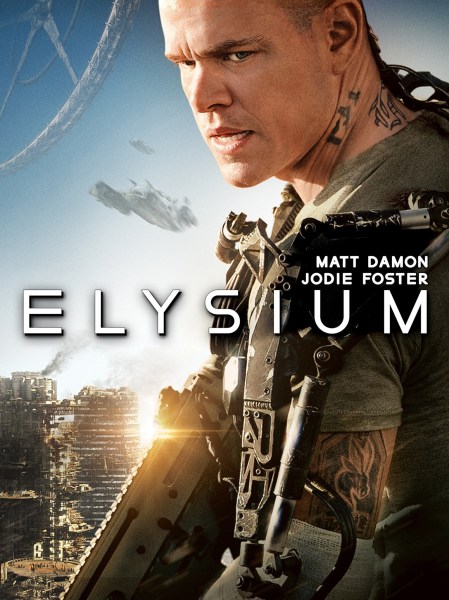
Suitable for framing!
There’s a smarter, sharper movie buried somewhere inside Elysium. All the ingredients are there: a compelling sci-fi premise, a solid cast, and a hot young director fresh off the surprise success of District 9. The result could have been something with a lasting cultural footprint. Instead, what ends up on screen is a jumbled, self-serious, occasionally cheap-looking film that knows what it wants to talk about—but never quite gets around to saying it.
Set in the year 2154, Elysium imagines a future where, for unspecified reasons, Earth has become a ruined wasteland. The wealthy have fled to a luxurious space station—also called Elysium—where resources are so abundant that sickness and even death are obsolete. Back on Earth, what remains of humanity survives under the watchful eye of Elysium’s ruthless Secretary of Defense, Jessica Delacourt (Jodie Foster). Passage to the station is strictly reserved for the elite, and Delacourt is more than willing to bend laws—or break them entirely—to preserve that order.

This is not the face of a rule follower.
Matt Damon stars as Max, a blue-collar worker who suffers a serious accident and is given only days to live. Desperate to reach Elysium, where advanced medical tech could save him, Max agrees to a dangerous mission: steal data from a member of the elite on behalf of an insurgent group. What follows threatens to unravel the carefully guarded social structure that separates the haves from the have-nots.
It’s a serviceable setup, even if it’s not particularly original. The film clearly takes cues from socially anxious sci-fi of the 1970s—films like Logan’s Run, Soylent Green, or THX 1138—each featuring a lone protagonist pitted against a cold, controlling system. Those stories weren’t always subtle, but they engaged seriously with their concepts. Elysium, by contrast, gestures toward big ideas, then boils them down until there’s nothing left but flavorless residue.

And punching!
Writer-director Neill Blomkamp, who co-wrote District 9 but handled this one solo, might have benefited from a second voice. District 9 was raw, thematically rich, and deeply unsettling. Elysium is more of a blunt instrument. It presents inequality as a binary and then solves it with a gun. There’s little room for ambiguity, and even less for reflection. Grand ideas are treated like aesthetic choices, not moral or philosophical dilemmas.
That kind of shallow storytelling would challenge even the best ensemble. Damon, Foster, and Sharlto Copley are all talented performers, but none are given the material they need to elevate the film. Damon is clearly committed to the gritty, dystopian action-hero role—he even bulked up significantly for it—but the film dresses him in what looks like a Target clearance T-shirt and slaps on a janky cyberpunk exosuit without so much as a rinse-off. Screws are literally drilled through the shirt into his body, which raises two immediate questions:
- Shouldn’t he be in septic shock by now?
- Why go through the trouble of transforming him into a cyborg if he still looks like he just came from a laundromat lost-and-found?
If Elysium had been made in the ’80s, that shirt would’ve been gone before the end of Act One. Here, we get a muted, awkward transformation scene, followed by 90 minutes of an Oscar winner stomping around in a suit made of trash, looking like he’s late for a post-apocalyptic CrossFit class.

Can’t be late…can’t be late…
I realize the outfit is meant to look cobbled together, but perhaps they went too far. Despite it being the most important prop in the film, I found it—and the lack of effective sound design for it—to be a constant distraction.
And if that seems unfair, let’s talk about Jodie Foster. She’s a legendary performer, but the film gives her nothing to work with—and whatever accent she’s going for doesn’t help. It’s part Lorne Michaels impression, part recovering dental surgery patient. Every time she speaks, the movie loses its footing. When she’s angry, you’re tempted to smirk. When she tries to deliver a villainous one-liner, it lands without impact.
Sharlto Copley fares a little better, but not by much. His character swings wildly between unhinged mercenary and drunken street prophet, never quite committing to either. He’s supposed to be Delacourt’s brutal enforcer, and this part of it kind of works. But he also feels like a character who wandered in from a more tonally aggressive movie like Demolition Man or RoboCop—and never found his way back out.

Always pull grenade pins with your middle finger. It blows up more.
Had any of these actors been given something meatier to chew on, Elysium might’ve been more than just a stylish misfire. But you can’t build depth out of such shallow material.
To its credit—setting aside the trash suit—the film looks great. Thanks to production designer Philip Ivey and concept artists like Syd Mead and George Hull, the robot sentries, spacecraft, and the Elysium station itself all feel like believable extensions of this world. The terrestrial environments feel lived-in, broken, and brutal—just as they should. The visual design is doing a lot of heavy lifting.

Unfortunately, it’s all in service of a story that never rises to meet it.
The problem isn’t the concept. The bones of the plot—a ruined Earth, a distant elite, medical technology hoarded like gold—are rich with potential. But the film refuses to engage with those ideas beyond surface-level outrage. It’s not so much a critique of inequality as it is a gesture toward it. The message is as clear as it is thin—rich people are greedy and bad—but beyond that accusation, Elysium has little to propose. It points at real problems, but mistakes anger for insight and certainty for depth.
It wants to be a rallying cry, but ends up as background noise—loud, angry, and quickly forgotten.
Special thanks to sheridan-j.deviantart.com for the artwork.
Categories

Bruce Hall View All
“When some wild-eyed, eight-foot-tall maniac grabs your neck, taps the back of your favorite head up against the barroom wall, and he looks you crooked in the eye and he asks you if ya paid your dues, you just stare that big sucker right back in the eye, and you remember what ol' Bruce Hall always says at a time like that: "Have ya paid your dues, Bruce?" "Yes sir, the check is in the mail."
 CRITICULT - Telling you what's up since 2003.