
White Christmas (1954)

Snoowwwww
Fun fact: I had never seen White Christmas before this year.
This is because musicals are a cultural blind spot for me. I’d never gotten my head around the idea of song interspersed with dialog as narrative. I understood how it worked, of course. I just could never develop the patience for that kind of storytelling.
But I’m older now and entirely capable of appreciating something outside my comfort zone. Also, you have to understand that my entire knowledge of White Christmas was based on stills like this:

I had no idea what to make of that, so of course, my mind filled in the gaps…
Old-timey radio announcer voice:
This holiday season, get ready for a Christmas tale like no other!
Join Bing Crosby as the Christmas King, Danny Kaye as the street-smart card-shark, and the dynamic duo of Rosemary Clooney and Vera-Ellen as a pair of spunky cigarette girls from the Windy city! Together, this quirky quartet must join hands to save the season!
It’s a yuletide adventure that will warm your heart and tickle your funny bone!
Get ready for laughter, love, and a sleigh-full of surprises in a Christmas story that will have you singing and dancing all the way! Don’t miss ‘White Christmas,’ the feel-good holiday extravaganza that’s as heartwarming as a cup of cocoa by the fireplace!
I was apparently off on some of the details.
The story opens in the waning days of World War II, where Captain Bob Wallace (Crosby) and the younger Private Phil Davis (Kaye) do their best to uphold unit morale with song and dance after their beloved General Waverly (Dean Jagger) is suddenly relieved of command.
Waverly is sent off with a soaring musical tribute (“The Old Man”) just as an enemy attack occurs, imperiling Wallace and bringing Davis to the rescue. If you look closely, this is also a teeny-tiny bit of a war movie. Not for “real,” of course, but it’s clear how much Waverly’s men respect him for leading them to the end of the conflict alive.
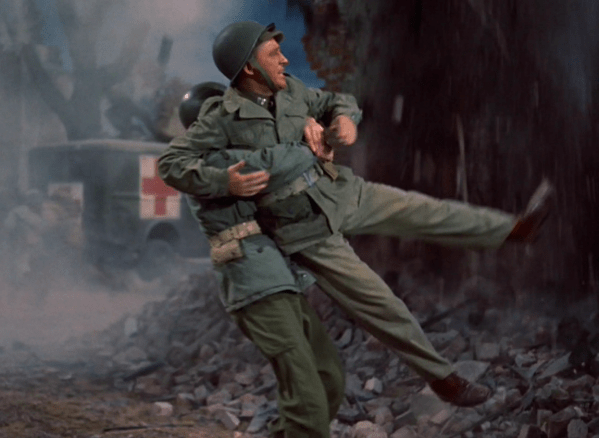
This is as much air as Crosby gets the whole movie
Postwar, the two pair up as entertainers based on the perceived debt owed by Wallace to Davis. They debut to great success, making a lot of money and friends, which puts them in a position to help the General out of a very specific jam some years later.
Things hit a snag when the boys cross paths with a similarly talented pair of performers in Betty (Rosemary Clooney) and Judy Haynes (Vera-Ellen). The women have problems of their own, and when the boys bail them out, they become part of Operation General Assistance.
Soon, love is evidently in the air because everyone in the story immediately decides that Bob and Betty should get married.
If that’s hard to follow, I’d urge you not to worry about it. White Christmas is less concerned with story logic than with the establishment of whimsy and spectacle. This caused my thoughts to occasionally wander to places the filmmakers likely never intended.
For example, I was deeply challenged by the idea of the much older Crosby being paired with the then-twenty-something Clooney. It wasn’t the obvious age gap that bumped me so much; it was the simple fact that I just couldn’t see them together.

No. Just, no.
Remember when I described how my mind used to have trouble making the logical leap into alternate forms of storytelling? Try imagining Hugh Jackman and Selena Gomez as romantic leads, and you’ll understand what White Christmas had me wrestling with.
I just wasn’t into this idea on any level.
And despite clearly being very fit, the Bingster seems mildly drained in this one. The first real stage number is “Blue Skies,” featuring Crosby and Kaye. They competently shuffle and glide back and forth in those memorable red jackets and boater hats…

..but you can tell even from stills that Crosby is less dynamic than his co-star, and I don’t say that to disparage the man. He does good work here, but it’s not his best work. In the film’s universe, we’re told that these guys are the hottest musical act in America, while in my mind I thought:
“Well, sure…when Mark Twain was alive.”
A better experience is “The Best Things Happen While You’re Dancing” with Kaye and Vera-Ellen. It’s a sweet and dreamlike dance on a whimsical stage, set to a sentimental vibe that, not unlike boater hats and show canes, seemed from another time even then.
Contrasting this somewhat is the merely adequate “Count Your Blessings.” It’s well performed by Clooney and Crosby, whose legendary vocal stylings work well with what is essentially a lullaby. But their struggle to generate romantic energy inadvertently drains the scene of momentum, which makes for some pretty solid unintentional irony.
Then there’s “Snow,” a song whose shambolic design makes it equally amusing and terrifying. It’s as though Paramount found compromising information on Irving Berlin and threatened him with it if he didn’t knock out a banger in five minutes.

Finish the song, Irving, or the dog gets it!
He didn’t.
The title track, “White Christmas,” wasn’t even written for this movie, and it gets dropped early in the runtime. This, anticlimactically, removes it from your list of expectations, akin to The Verve opening a show with “Bittersweet Symphony.”
It’s not that there isn’t great stuff here.
My favorite scene in the film is a critical long take that requires Crosby and Kaye to seriously emote and perform some sharply subtle physical comedy. Much of the time, other people come in and out of the room. I watched it again and again before going forward with the film. It was the first thing that made me truly sit up and take note of the narrative.
Still, “Is this all there is?” I thought. “Is there nothing more?”
Well, remember what I said earlier about Vera-Ellen? The final act is, of course, devoted to tying up our humdrum, low-stakes story threads. But it’s also the genesis of multiple breathtaking numbers where Vera-Ellen kicks and slices her way across the screen in a way even the fleet-footed Kaye can’t match.
She is a live wire, a dynamo, and everything else you’ve ever heard about superlative human movement.

Perhaps White Christmas is a masterpiece if only by being so committedly bland for most of its duration, only to transform into something bigger and more spectacular than it had any right to be. I’d say it succeeds not necessarily as a story and probably not even entirely as a musical.
It excels initially based on Kaye’s impish charm, Clooney’s effortless grace, and Crosby’s status as an icon. But it’s all kind of a head-scratcher until the backside of the film. This is primarily carried by the uncanny ability of Vera-Ellen and, eventually, the combined efforts of all in a genuinely rousing final number.
It takes a lot to get it across the finish line, but I have difficulty comparing White Christmas to other musicals. It’s in a unique category by virtue of its makeup and participants. And despite its flaws, it lands on its feet and succeeds on its own terms.
It’s the feel-good holiday extravaganza that’s as heartwarming as a cup of cocoa by the fireplace!
Warning: This is one of those old-school trailers that essentially shows you the whole damn film condensed into two minutes.
Categories

Bruce Hall View All
“When some wild-eyed, eight-foot-tall maniac grabs your neck, taps the back of your favorite head up against the barroom wall, and he looks you crooked in the eye and he asks you if ya paid your dues, you just stare that big sucker right back in the eye, and you remember what ol' Bruce Hall always says at a time like that: "Have ya paid your dues, Bruce?" "Yes sir, the check is in the mail."
 CRITICULT - Telling you what's up since 2003.